
Behaviorism is not behaviorism is not behaviorism
picking up where we left off, not all "behaviorism" is the same, radical behaviorism is my jam
Hi readers,
It’s been several weeks since my last post in this publication, Behavior Curious. I promised weekly posts, which turned out to be… ambitious. To recalibrate, please expect variability — posts will be on more of a random- or variable-time schedule than a fixed-time schedule. Thank you for being here regardless of frequency!
Before we get into today’s topic, here’s a quick recap of where we’ve been so far — for you and me both!
Recap of Posts to Date
Short intro with a few recommended readings
Prelude and welcome to “Behavior Curious”
Covered my intentions
Not trying to convert laypersons to die-hard behaviorists, just want to offer basics and history, spark curiosity, correct misunderstandings, soften our edges a bit
Would like to tease out material that might lead to an e-book, course, or something sellable. (I’ve been giving away a lot for free!)
Explored the Radical Behaviorist view that “behavior” includes everything we do, say, think, and feel (public and private) that is not purely physiological.
Addressed the common misconception that behaviorists ignore thoughts and feelings. We don’t. This misconception stems from behaviorism from over 100 years ago — covered in today’s post.
B.F. Skinner and his “radical” assumptions
Brief historical context, introduction to Skinner
Outlined the philosophical tenets, or underlying assumptions, of Radical Behaviorism as a philosophy of science
made the philosophical tenets layfriendly, please check it out!
And that’s when I paused for several weeks. There are dozens of natural next steps (omitting for the sake of time). I wanted a linear path… but this topic, “Radical Behaviorism/Behavior Analysis” in all its complexity, is not a linear path.
And then it hit me:
The challenge I face in any given post is to meet the organism (reader) where you are. I don’t know where that is, at any given time, but I do know one thing:
Most people don’t know that “behaviorism” names a messy, branching family tree with many variations — methodological, teleological, radical, cognitive-behavioral, contextual, post-Skinnerian, etc. — not a single unified theory.
When I say the word “behaviorism,” every listener comes from a different place.
So, today’s post is an attempt to meet the average lay reader where they are:
first, at the word “behaviorism”
then, at the word “radical”
by way of history, and AI example.
Behaviorism Is Not Behaviorism Is Not Behaviorism
When people criticize “behaviorism,” broadly, I know their understanding is limited. Not because there’s nothing to criticize! Because it’s like saying all Western Medicine is bad.
Behaviorism is not behaviorism is not behaviorism! That is, the word “behaviorism,” out of anyone’s mouth — even those of behaviorists — does not mean the same thing.
What do people mean when they say “behaviorism”?
Sometimes they mean Pavlov, who was a physiologist, not a behaviorist, and stumbled onto describing one type of learning, classical or respondent conditioning.
Sometimes they’re talking about J.B. Watson’s methodological behaviorism, in which respondent conditioning was the focus, and thoughts and feelings were moot points.
Sometimes they mean B.F. Skinner, whose theory of operant conditioning and complex philosophy of radical behaviorism have been highly misunderstood and unfairly criticized for things he never said, meant, or did.
Sometimes they mean applications behavior analysis, or ABA — particularly with autistic people — which is a whole can of worms coated in the dirt of broader cultural maladies (ableism and capitalism and advantage-takers thereof).
Sometimes they are referring to the caricature of behaviorism as portrayed in media such as “Clockwork Orange,” and the like.
Sometimes they mean a vague stereotype of the Experimental Analysis of Behavior involving rats, levers, and cold-hearted scientists manipulating children with M&M’s.
Sometimes they think “behavioral therapy,” or worse, “conversion therapy,” the latter of which is a dark (and very small) blip in our field’s applications.1
Sometimes they mean CBT (which is not behaviorism but shares a name fragment).
Sometimes they think of the token boards, behavior contracts, and visual aids used by teachers and educators who, despite having no formal training in the science or application of behavior analysis are given the title “Behavior Specialist” in schools across the nation. 2
Sometimes, if the words “behavior analysis” are used, they’re thinking of the Behavioral Analysis Unit of the FBI. Tracking criminals and serial killers.
And, sometimes…
Sometimes, they are referring to what their AI-based search engine told them.
Let’s dig into the last one a little more, as it gets at the core of the problem: decades of misinformation and disinformation in the public eye.
AI is just as confused as most people — and that’s telling
Here’s an example from just now, 11/18/25:
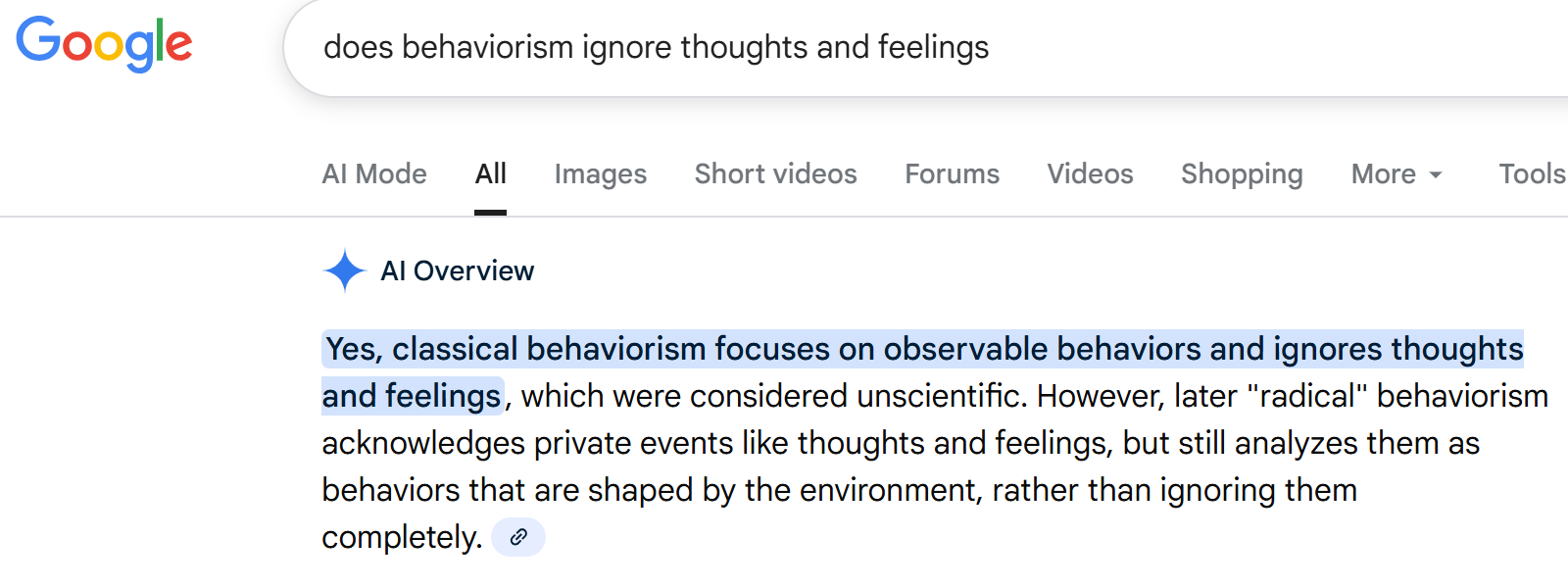
“Does behaviorism ignore thoughts and feelings?”
Google’s answer was an immediate “yes,” which is disappointing, considering most of us haven’t ignored thoughts and feelings since before the 1920s. It also mentioned “classical behaviorism.” Not sure what that is. No one refers to Methodological Behaviorism that way.
Now, to be fair, this isn’t a definition of behaviorism (which wasn’t terrible). But no one is basing their opinions of a philosophy and science on its definition. They ask their AI-based search engine questions like this, have their misinformation confirmed, decide it doesn’t fit what they know of how the world works — or how others say it does — and dismiss behaviorism on its face.
Seems like, after 100+ years of behaviorists of all stripes not ignoring thoughts and feelings, the answer AI should give is:
"No, most forms of behaviorism do not ignore thoughts and feelings. But it’s complex. Methodological behaviorism, pre-1920 did not consider thoughts and feelings relevant to theory or application, but almost every form of behaviorism since B.F. Skinner (1930s on) has considered thoughts and feelings to be subject to the same principles and laws as overt behavior. The challenges for science are observability and measurement3, but those can be overcome.”
Of course, AI isn’t the only source of misinformation about behaviorism/behavior analysis — as a teaser, I have a future post about sources of misinformation cued up — but the fact that AI-generated answers to questions about behaviorism contain misinformation is telling of the larger problem we face:
The word “behaviorism” has been used — by psychologists, philosophers, showbiz, and the general public — to refer to very different viewpoints across 100+ years. The confusions about “behaviorism” are complex, everywhere, and deeply embedded in printed materials. And their volume outweighs that which behaviorists contribute to public print.
Given how AI is trained, the presence of mis- and dis-information about behaviorism in AI answers makes it clear:
AI is confused about behaviorism because most people are confused about behaviorism.
So, if you can stick with me a tad longer, what follows is a quick historical overview of behaviorism — and “radical” behaviorism — to help you stay smarter than AI.
Watson’s Methodological Behaviorism (1913-1920-ish)
John B. Watson coined the term behaviorism in 1913 in his “Behaviorist Manifesto,” which, in retrospect, was a little strong out of the gate.4
Watson’s methodological behaviorism:
embraced respondent, or classical, conditioning (stimulus-response learning)
rejected introspection, the primary focus of psychology at the time (“discovering” causal phenomena through self-inspection alone)
treated psychology as a natural science
limited itself to observable behavior on the outside
either denied or bracketed “consciousness”
And there is some confusion over the term “radical,” too. Early 1920s psychologists described Watson’s take as “radical,” “extreme,” “strict,” or “orthodox” behaviorism — not because Watson used those words, but because his stance on consciousness was, in their view, iconoclastic and bold.
Watson never used the term “radical behaviorism” himself.
But the term did appear in print as early as 1921 (Calkins), referring to Watson’s behaviorism.5
Already, “behaviorism” meant multiple things. Already, “radical” mean something unbudging, something rigid, something… non-Skinnarian. We can see the confusion and animosity already starting to bubble, can’t we?
Skinner’s Radical Behaviorism (1930s - on)
When I say “behaviorism,” I’m referring to the philosophy of Radical Behaviorism, as espoused across decades by B.F. Skinner.
In the 1930s, Skinner began developing his own philosophical system for the science of behavior — not based on Watson’s methodological behaviorism, more influenced by Mach, Hume, Bacon, and others.
In 1945, Skinner used the term “Radical Behaviorism” for the first time in print.
Skinner’s “radical” wasn’t about extremism. He meant “thoroughgoing” — that the same principles that explain an organism doing explain organism saying, thinking, feeling — and that all this behavior is the subject matter of “psychology,” not as states, traits, drives, moods, personalities, brain/nervous system, personal characteristics, or invented hypothetical variables, but behavior itself.
What was radical was that he was saying — to other psychologists, other behaviorists, medical doctors, laypersons, housewives, educators, religious scholars, linguists… to everyone, the entire world — everything we usually consider “psychological” or “mental” should be operationally definable, observable, countable, measurable, able to be experimented upon — including private events. That is, behavior, inside and out, is the relevant dependent variable in a natural science of psychology, not anything else.
So, importantly:
Skinner included private events (thinking, feeling, remembering) as behavior — part of the subject matter to be analyzed, and subject to the same principles and laws as all other behavior, even if not directly observable by others.
This belief alone — private events are behavior — differentiates Radical Behaviorism from many other versions, including teleological behaviorism6, which views thoughts as extensions of overt behavior, and “CBT,” which views thoughts as products of hypothetical and unobservable variables (which, say it with me, is not behaviorism because…well, determinism, bitches).
Other Meanings of “Behaviorism”
Historical accounts 7 8 9make it clear that behaviorism splintered early and often. Here are the more known variations:
Methodological behaviorism (as in Watson — observable behavior only, treat private events as outside science)
Interbehaviorism (Kantor — reciprocal field interactions, I haven’t read much)
Teleological behaviorism (Rachlin — molar units, extended patterns over time)
Neo-behaviorism (Hull, Tolman — very different from Skinner)
Behavioral therapies (Kazdin, Krasner — broader than ABA for autism)
CBT / “cognitive behaviorism” (again, shares a root word but is not behaviorism)
Contextual behaviorism/ contextual science (Golddiamond and others…)
And that’s before we even get to:
The Experimental Analysis of Behavior — the basic science that seeks to identify principles, or laws, of behavior that are generalizable
Applied Behavior Analysis (ABA) — the application of the science
“Behavior Analysis” — the overarching discipline including EAB, ABA, and the philosophy of radical behaviorism
“Behavioral Science” — a new-ish term that, as far as I can tell, refers loosely to behaviorism of any kind but seems to be less aversive than “behaviorism” to most
It’s no wonder the average psychology student — or AI system, newspaper writer, Substacker — who tries to make sense of “behaviorism” emerges with confusion.
Why This Matters for Behavior Curious
I needed to clear the air.
I needed readers to understand what distinguishes Radical Behaviorism + Behavior Analysis from other types of behaviorism. So, if anyone joins us later on, I have a foundational post to which to refer them, for context of the kind I’m speaking of.
And, in fact, this topic is important more broadly, to dissemination and “saving the world with behavior analysis + other fields of study.” As others have pointed out, the murky waters of behaviorism — decades of diversions and misunderstandings, many of which remain paywalled — prevent parallel with other disciplines and “isms” (e.g., feminism10).
So, this post lays down the conceptual scaffolding we need so the next steps — whichever steps we take — make sense.
You now know:
why Watson’s behaviorism is not Skinner’s behaviorism
where the term “radical behaviorism” came from
what Skinner meant by “radical”
behaviorism DOES NOT ignore thoughts and feelings — hasn’t in 100+ years
why one cannot critique “behaviorism” as one unified discipline (it’s not)
why confusion and misconceptions are built into history itself
why most people resist the word “behaviorism” (they don’t know what it means, fully, and media connotations have not been favorable)
what radical behaviorists / behavior analysts are up against (well, you have a peek)
The Road Ahead (No Promises)
Now that we’ve made sense of what I mean when I say “behaviorism” — as opposed to what you might know or hear elsewhere — here is where we might go next:
misconceptions about behaviorism
the philosophical tenets (determinism, empiricism, parsimony…) with everyday examples
“behavior analysis” as a term that encompasses the sub-disciplines of the experimental analysis of behavior, applied behavior analysis, clinical application, and philosophical foundations
Most likely, I’ll weave back and forth between these and other topics.
This publication is not a textbook. It’s the product of an organism behaving — influenced by variables outside and inside my skin, on topics that interest me (and you), the questions you ask, and the broader contingencies that shape my writing.
If there’s a particular misconception, historical question, or tenet you’d like me to explore sooner rather than later, feel free to drop it in the comments.
Thanks for reading. And thanks for being Behavior Curious with me!
Peace, love, and stimulus control,
Jennifer
Morris, C., Goetz, D. B., & Gabriele-Black, K. (2021). The treatment of LGBTQ+ individuals in behavior-analytic publications: A historical review. Behavior Analysis in Practice, 14(4), 1179-1190. https://pmc.ncbi.nlm.nih.gov/articles/PMC8586111/pdf/40617_2020_Article_546.pdf
If looking for a professional behaviorist, the credential of Board Certified Behavior Analyst, BCBA®, guarantees the person met minimal training standards and has over 1K hours of supervised experience.
Another challenge is that, when we talk about private events, that’s new verbal behavior, under the control of new and different variables than the private events we’re discussing. Let’s not linger in this philosophical conundrum now!
Schneider, S. M., & Morris, E. K. (1987). A history of the term radical behaviorism: From Watson to Skinner. The Behavior Analyst, 10(1), 27-39. https://pmc.ncbi.nlm.nih.gov/articles/PMC2741938/pdf/behavan00060-0029.pdf
Morris, E. K. (2013). The legacy of John B. Watson’s behaviorist manifesto for applied behavior analysis. Revista Mexicana de Análisis de la Conducta, 39(2), 156-179. https://www.redalyc.org/pdf/593/59335808009.pdf
Rachlin H. (2018). Is talking to yourself thinking?. Journal of the experimental analysis of behavior, 109(1), 48–55. https://doi.org/10.1002/jeab.273
Morris, E. K. (2022). Teaching a course on the history of behavior analysis. Perspectives on Behavior Science, 45(4), 775-808. https://pmc.ncbi.nlm.nih.gov/articles/PMC9685156/pdf/40614_2022_Article_357.pdf
Day, W. F. (1969). Radical behaviorism in reconciliation with phenomenology. Journal of the Experimental Analysis of Behavior, 12(2), 315. https://pmc.ncbi.nlm.nih.gov/articles/PMC1338563/?page=1
Day, W. (1983). On the difference between radical and methodological behaviorism. Behaviorism, 89-102. https://www.jstor.org/stable/27759016
Ruiz, M. R. (1995). BF Skinner’s radical behaviorism: Historical misconstructions and grounds for feminist reconstructions. Psychology of Women Quarterly, 19(2), 161-179. https://link.springer.com/content/pdf/10.5210/bsi.v5i2.221.pdf
…in an informed and accessible way. Nicely done
Great post. Covers a lot of ground but